Recipes · Autumn · Party
Autumn Party Food a buffet that's ready before the doorbell
A summer party forgives almost everything. You set a bowl on the table, someone turns up with a melon, the grill takes care of the rest – and while it is still light at ten, nobody notices there was never really a plan. Autumn is less generous. By seven it is dark, everyone is indoors, and indoors means one room, which also happens to be the kitchen. So I plan an autumn buffet backwards now. I don't ask what I feel like cooking; I ask what can be finished before the first coat goes on the hook.
Last updated: 2026-09-04
 Pin it
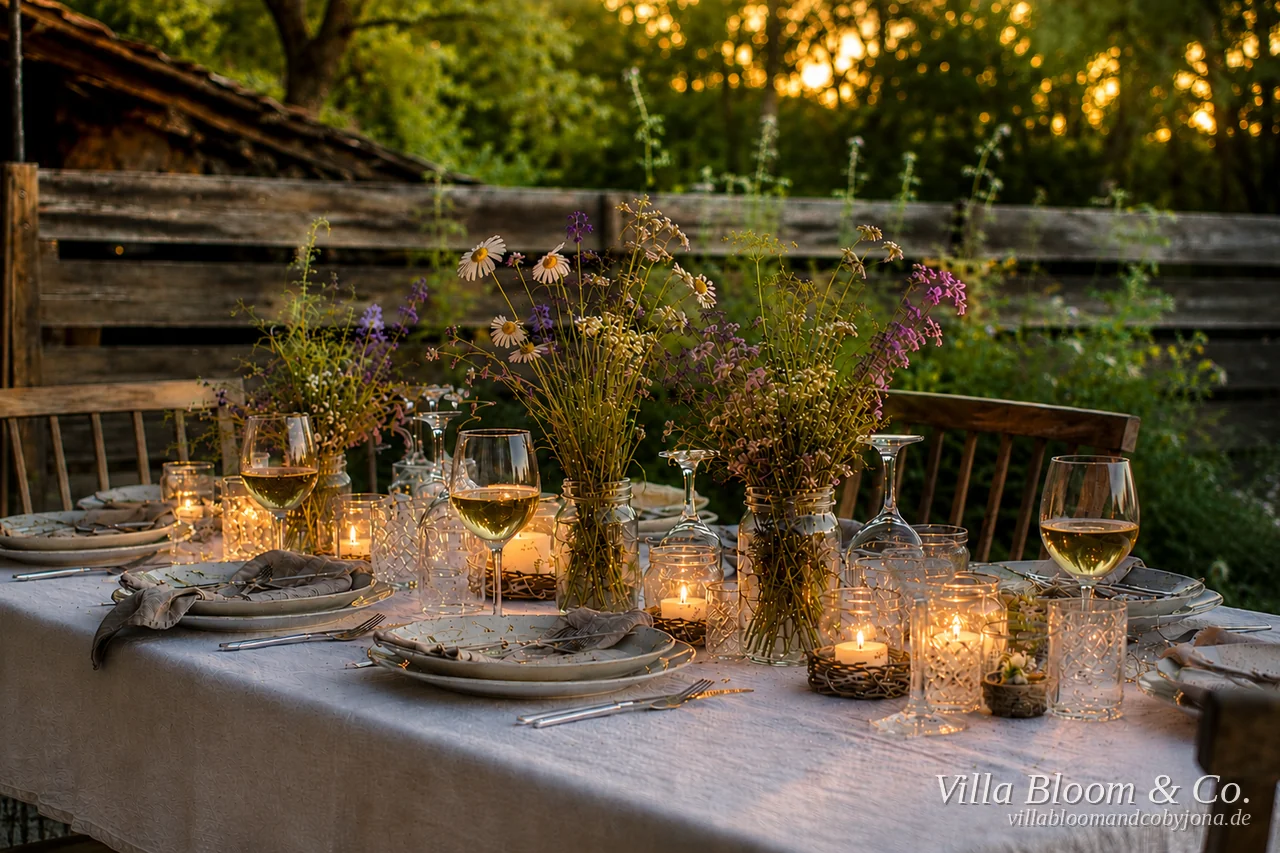
Two levels, a lot of small candles, one branch laid across – an autumn buffet needs no more setting up than that.
What makes an autumn party different
Three things change once the evenings get dark, and all three work in your favour if you plan for them.
The oven becomes an ally instead of an enemy. In July I bake reluctantly. In October a warm oven is half the reason the house feels good. Almost everything on this list goes onto a baking tray, and trays can be stacked, made ahead and warmed through again.
Your guests stay in one place. The garden is gone as a second room. Which means a table people walk past several times works better than one grand serving moment. Small portions, topped up again and again.
Warm beats cold. A buffet of nothing but cold platters can be as good as you like – in autumn it still feels as though something is missing. There has to be at least one thing that steams. It can be a small thing; one tray of onion tart will do. But it has to exist.
The three rules if you take nothing else away
If you remember one thing from this article, let it be these three lines.
1. Everything can be eaten with one hand. Standing up, glass in the other hand. That rules out soup, salads with long leaves, and anything that has to be cut up first. A small fork or a spoon already in the glass is the exception that works beautifully: the cutlery is there, you pick both up together and put both down together. Which is why the slaw and the dessert are allowed to join in – on a plate they would be more trouble.
2. In the last half hour, things are only reheated. Warming through and assembling are fine, even with someone already in the room. Actual cooking in that half hour is rarely relaxed.
3. Three kinds on the table. Something warm, something cold, something to dip into. Strictly speaking that is two temperatures and a texture – but it is this division into three that makes a table look considered, even when there are only five things standing on it.
Warm from the oven the heart of the buffet
Savoury pumpkin and feta muffins
I make these every single time. They are best lukewarm, but they will sit on a table for two hours without sulking – and there is almost nothing else on this list I can say that about.
Makes 12
- 300 g Hokkaido pumpkin, coarsely grated with the skin on
- 200 g plain flour
- 1 level tsp baking powder, ½ tsp bicarbonate of soda
- 2 eggs
- 120 ml milk, 60 ml neutral oil
- 150 g feta, roughly crumbled
- 1 tsp salt, plenty of pepper, ½ tsp smoked paprika
- 2 tbsp pumpkin seeds
Mix the dry ingredients in a bowl. Whisk the eggs, milk and oil, add them and stir only until no flour is visible – the batter is allowed to look lumpy. Fold in the grated pumpkin and two thirds of the feta. Spoon into greased muffin tins, scatter the rest of the feta and the seeds on top.
25 minutes at 180 °C / 350 °F, conventional. Test with a skewer, but don't leave it too late: the pumpkin keeps them moist, and that is exactly what you want.
Make ahead: Bake the day before, keep in a tin, warm through for 8 minutes at 150 °C / 300 °F before the party.

Onion tart from the tray, cut into squares
Onion tart is autumn in its most honest form. Cut into squares it stops being a tart and becomes something you can eat standing up, one-handed, mid-sentence. That is the entire trick.
For a 40 × 30 cm baking tray – cut 6 × 4 it makes 24 squares of about 7 × 7.5 cm
- 1 sheet of ready-rolled puff pastry (or yeast dough, if you have the time)
- 1 kg onions, in fine half-rings
- 150 g streaky bacon, diced – or 150 g mushrooms for the vegetarian version
- 200 g soured cream, 2 eggs
- 1 tsp whole caraway seeds
- Salt, pepper, nutmeg
Render the bacon, then soften the onions in the fat over medium heat for 20 minutes – not browned, just translucent and collapsed. For the vegetarian version, heat 2 tbsp butter instead, fry the mushrooms until their liquid has evaporated, and only then add the onions: without any fat they don't soften, they dry out. Let the mixture cool completely, or the egg will curdle. Stir the soured cream with the eggs, season, and combine with the onions.
Spread onto the pastry, scatter the caraway over. 30 minutes at 200 °C / 400 °F, until the surface takes on patches of colour.
Make ahead: The onion mixture keeps for two days in the fridge. The tart itself is baked on the day, but it can be finished in the late afternoon and go onto the table lukewarm.

Roast pumpkin with honey and mustard, on skewers
Left plain, roast pumpkin sits politely on a buffet and stays there. With the honey and mustard on it, it is the first thing gone. I found that out by accident, the year I put both versions on the same table.
Makes about 20 skewers
- 1.2 kg Hokkaido pumpkin, in 3 cm cubes (skin left on) – 250 g of it goes into the hummus after roasting, the rest gets glazed
- 3 tbsp olive oil
- 1½ tbsp honey, 1½ tbsp wholegrain mustard
- 1 tbsp cider vinegar
- Salt, pepper, a few sage leaves
Toss the pumpkin with oil, salt and pepper and roast for 25 minutes at 200 °C / 400 °F. Set 250 g aside for the hummus. Stir the honey, mustard and vinegar together, pour over the remaining hot pumpkin, add the sage and give it another 5 minutes in the oven. Thread onto short wooden skewers while still lukewarm, two or three cubes each.
Make ahead: Everything up to the threading can be done in the morning. Thread them shortly before – otherwise the wood goes soft.
Cold and long since finished
Pear crostini with blue cheese and walnut
The prettiest thing on the table takes the least time. I find that mildly unfair, and I have made my peace with it. Four ingredients on toasted baguette.
Makes 24
- 1 rustic baguette, about 250 g – cut on a steep diagonal into 1.5 cm slices it gives a good 24 pieces
- Olive oil
- 150 g mild blue cheese, at room temperature
- 1 romaine heart – only the small inner leaves are needed
- 3 firm pears, in thin slices
- 50 g walnuts, roughly chopped and dry-toasted
- Honey and thyme to finish
Brush the bread with oil and toast for 6 to 8 minutes at 200 °C / 400 °F, until the edges are crisp and the middle still gives a little. Let it cool completely. Then, in this order: a small romaine leaf on the slice, the cheese on top in rough pieces rather than smoothly spread – you want to see it – two or three thin slices of pear, walnuts, a drop of honey, a little thyme.
The lettuce leaf is not decoration, it works. It puts a layer between the bread and a juicy topping – together with topping them late, that helps keep the crostini crisp. It is not a miracle: a lettuce leaf brings moisture of its own, which is why it has to be patted dry. Take the small inner leaves from the heart: firm, slightly cupped, dry enough. Soft, watery kinds like butterhead, iceberg or lamb's lettuce give off more than they hold back, and do the opposite of what you wanted.
Two small movements decide this one: pat the leaf dry, and tear it smaller than the slice. If it hangs over the edge, the whole topping slides out with the first bite.
What the bread has to manage is holding the topping without folding when you bite. A rustic baguette with an open, firm crumb does that well – not a soft part-baked sandwich baguette, which goes hard rather than crisp in the oven. Cut on a steep diagonal, the slices are long enough for cheese, pear and nut side by side, and still easy to eat with one hand. A slice like that does go soft faster than a coarse country loaf, and that is exactly why topping them appears twenty minutes before the doorbell in the plan.

Make ahead: Toast the slices the day before and keep them airtight in a tin. Topping happens in the twenty minutes before the doorbell – any earlier and the bread goes soft. This is the one exception to rule two, and it lasts a quarter of an hour.
Red cabbage and apple slaw in jars
A big bowl of slaw at a standing buffet is a small unkindness. In little jars, with a spoon already in, it turns into something you can carry across the room with you.
For 12 jars of 100 ml
- 800 g red cabbage, very finely shredded
- 2 tart apples (Bramley or Braeburn), coarsely grated
- 6 tbsp cider vinegar, 4 tbsp walnut oil
- 2 tbsp maple syrup, 2 tsp Dijon mustard
- 1 tsp salt
- 120 g walnuts, roughly chopped
- Seeds of 1 pomegranate
Knead the shredded cabbage hard with the salt in a large bowl for five minutes, until it collapses and darkens – that replaces any blanching, and it is the only reason the slaw doesn't taste of raw cabbage. Whisk the vinegar, oil, maple syrup and mustard, stir it through, and add the grated apple last.
The walnuts and pomegranate seeds only go in when you fill the jars. Left to sit for two days, the nuts go soft and the pomegranate bleeds out.
For a party nothing else changes except the serving: small 100 ml jars, filled two thirds, a short wooden spoon on top.
Make ahead: This slaw is better the day after than it is fresh. Fill the jars in the morning.

An autumn board instead of a cheese plate
Not a recipe, an arrangement – and reliably the corner where people stand longest.
Three cheeses are enough, more doesn't register: one soft, one semi-firm, one strong. With them, whatever is around: grapes, figs, pear slices, walnuts, prunes, a jar of quince compote. Quince and blue cheese belong together so naturally that it feels planned.
One thing I learned late: cut everything open beforehand. Nobody wants to be the person who makes the first cut into a whole camembert.
Two bowls to dip into and one bread
Two dips, one bread. That is the amount at which the corner looks full without you having to shuffle three bowls around.
Pumpkin hummus
- 400 g chickpeas, drained weight (1 large jar), rinsed
- 250 g roast pumpkin (it comes off the same tray as the skewers)
- 3 tbsp tahini, juice of half a lemon
- 1 small garlic clove
- 1 tsp ground cumin, salt
- 3 tbsp olive oil, plus a little cooking water or plain water
Blend everything smooth, loosening with water to a soft, spreadable consistency. To serve, press a hollow into the surface, pour olive oil into it and scatter toasted pumpkin seeds over.
Beetroot dip with horseradish
The colour alone earns it a place on the table. If I am honest, I make it for the pink.
- 300 g cooked beetroot
- 200 g soured cream or skyr
- 1 to 2 tsp horseradish from a jar
- 1 tsp cider vinegar, salt, pepper
- Dill or chives
Blend the beetroot smooth, stir in the rest, and let it sit for at least an hour.
Torn oven bread chips
Tear flatbread or stale white bread into strips – tear, don't cut, torn edges crisp up better. Toss with oil and salt, 12 minutes at 190 °C / 375 °F.
Make ahead: The beetroot dip is made two days before, the hummus in the morning – its pumpkin comes off the same tray as the skewers. Kept in closed jars and continuously refrigerated, both last two to three days. The chips the day before, in a tin.

Sweet, but from a tray
A proper cake at a standing party needs a plate, a fork and a free hand. A tray bake in cubes needs none of the three – which is why there is a tray here and not a tin.
Plum tray bake, cut into squares
Better on the second day, which is the kindest thing you can say about a cake you are baking the night before anyway.
For a 40 × 30 cm baking tray – cut 6 × 4 it makes 24 squares of about 7 × 7.5 cm
- 1 kg plums, halved and stoned
- 250 g flour, 100 g sugar, 125 g soft butter, 1 egg, 1 tsp baking powder, a pinch of salt
- 3 tbsp ground hazelnuts for the base
- Cinnamon sugar
Knead a shortcrust from the flour, sugar, butter, egg, baking powder and salt, chill it for half an hour, then roll it out on the tray. Scatter the ground hazelnuts over – they take up the juice and keep the base dry. Lay the plums on close together, overlapping like roof tiles.
40 minutes at 180 °C / 350 °F. Cinnamon sugar goes onto the cake while it is still warm.
Make ahead: Bake the day before.

Chestnut and vanilla cream in glasses
For everyone who wants something to spoon after all the savoury things.
For 12 small glasses
- 400 g sweetened chestnut purée from a jar
- 400 g cream, whipped stiff
- 300 g quark
- 1½ tsp vanilla extract
- Toasted hazelnuts to scatter over
Beat the chestnut purée smooth with the quark and vanilla, then fold in the cream. Fill the glasses, chill, and only scatter the nuts on just before serving.
Make ahead: The day before. Nuts at the very end, or they go soft.

One thing to drink that steams
One warm drink changes the mood of an evening more than three extra dishes. I don't entirely understand why. I only know that it does.
Apple and elderberry punch, alcohol-free
Makes 2 litres
- 1.5 l cloudy apple juice
- 500 ml elderberry juice
- 2 cinnamon sticks, 4 cloves, 2 star anise
- 1 unwaxed orange, sliced
- A thumb-sized piece of ginger, sliced
Heat everything together, but don't let it boil hard – the longer the cinnamon, cloves and star anise cook, the more stern and dominant they get. Let it steep at 80 °C / 175 °F for half an hour, then strain; that keeps the fruit and the spice in balance.
Make ahead: Start it in the morning, leave it in the pan, warm it through again before serving. If you like, stand a bottle of dark rum next to it rather than pouring it in – then everyone can join.

How much you actually need
The commonest mistake is not too little, it is too much. Standing up, people eat differently than they do at a table: several small things rather than one full plate.
As a rough guide, per person:
- 4 to 6 savoury bites in total, across the whole evening
- 2 sweet pieces
- 3 to 4 drinks, one of them warm
For twelve guests that is 48 to 72 savoury bites. The four savoury recipes here add up to 80 – which is why what's on this page is a selection, not a menu. Three of the four are plenty for twelve people, along with the slaw, the autumn board and the two dips.
Three combinations that work well:
- Classic – onion tart, muffins, crostini. 60 pieces. One hot tray, one lukewarm, one cold thing.
- No oven in the evening – muffins, pumpkin skewers, crostini. 56 pieces. The onion tart is the only thing still being baked in the late afternoon; without it the kitchen stays cold.
- When people are properly hungry – onion tart, skewers, crostini. 68 pieces. The largest amount, without anything sweet going missing.
All four together is not a mistake – the muffins, the onion tart and the cakes all keep – but then you are shopping and baking for an evening and a half. The sweet things stay complete either way: the plum cake and the cream come to about three pieces per person, and both are still good the next day.
Every quantity above, and the shopping list below, is calculated for twelve guests and covers all four savoury dishes. What you can leave out if you settle on three is at the end of the shopping list. For six guests, halve everything except the dips – you can still eat those the next day; onion tart, less so.
The shopping list one lap of the shop
Sorted by aisle, so you walk through the shop once rather than three times. The things almost everyone has at home – salt, pepper, oil, sugar, flour – are on it anyway, because those are exactly what turns out to be missing the night before.
Fruit and vegetables
- 2 Hokkaido pumpkins, about 1.6 kg together – 300 g are needed for the muffins and 1.2 kg for the skewers and the hummus, the rest is trimmings and spare
- 1 kg onions
- 1 kg plums
- 5 pears (3 firm ones for the crostini, 2 for the board)
- 2 tart apples for the slaw
- 1 red cabbage, about 800 g
- 1 unwaxed orange
- 1 lemon, for the hummus
- 1 pomegranate for the slaw
- 1 piece of ginger, thumb-sized
- 1 bulb of garlic
- 300 g cooked beetroot (vacuum-packed)
- 1 punnet of grapes
- 2 to 3 fresh figs, if they are still around
- 1 bunch of dill or chives
- 1 small bunch of thyme, a few sage leaves
- 1 romaine lettuce – only the inner leaves are needed for the crostini
- 150 g mushrooms and 2 tbsp butter, if the onion tart is to be vegetarian
Chilled
- 5 eggs (2 muffins, 2 onion tart, 1 plum cake) – buy six, one in reserve
- 400 g soured cream (200 g for the onion tart, 200 g for the dip – skyr works too)
- 400 g cream
- 300 g quark
- 150 ml milk
- 125 g butter
- 150 g feta
- 150 g mild blue cheese
- 3 cheeses for the board, about 200 g each: one soft, one semi-firm, one strong
- 150 g streaky bacon (not needed for the vegetarian version)
- 1 sheet of ready-rolled puff pastry
Store cupboard
- 450 g flour
- 100 g sugar, plus cinnamon sugar
- Baking powder, bicarbonate of soda
- 1 large jar of chickpeas, 400 g drained weight
- 3 tbsp tahini
- 400 g sweetened chestnut purée
- 220 g walnuts (120 g for the slaw, 50 g for the crostini, the rest for the board)
- 100 g hazelnuts, plus 3 tbsp ground hazelnuts
- 50 g pumpkin seeds
- 1 jar of quince compote – or your own
- A handful of prunes
- Honey, maple syrup, wholegrain mustard, Dijon mustard, horseradish in a jar
- Cider vinegar, olive oil, neutral oil, walnut oil
- 1 rustic baguette (about 250 g), 2 flatbreads
Spices
- Cinnamon sticks, cloves, star anise
- Whole caraway, ground cumin
- Smoked paprika
- Nutmeg, vanilla extract
- Salt, pepper
Drinks
- 1.5 l cloudy apple juice
- 500 ml elderberry juice
- 1 bottle of dark rum, in case anyone wants to top up their punch
- Whatever else you are offering, counted at 3 to 4 glasses per person
Not for eating
- 20 short wooden skewers
- 12 small 100 ml jars and 12 dessert glasses, plus short wooden spoons and small dessert spoons
- Baking parchment, cling film, two large tins with lids
- A lot of small candles (tea lights or short pillars)
If you only make three savoury dishes
The list above covers all four. Depending on what you drop, cross off:
- Without the muffins: feta, 200 g flour, the milk, two eggs and the smoked paprika. Pumpkin from 1.6 kg down to 1.2 kg.
- Without the onion tart: puff pastry, the onions, bacon (or mushrooms and butter), two eggs and the caraway. Only halve the soured cream – the beetroot dip needs 200 g.
- Without the skewers: the wooden skewers and the wholegrain mustard. Pumpkin down to 550 g – 300 g for the muffins, and 250 g still have to stay for the hummus, which otherwise loses its pumpkin.
- Without the crostini: the baguette, blue cheese, the three firm pears, 50 g walnuts and the romaine. Thyme and honey stay – the honey also goes into the glaze.
Getting ready step by step
The timeline is really the heart of this article. Follow it and there is nothing left to do in the evening except light the candles.
Two days before – about 45 minutes
- Slice the onions into fine half-rings. Render the bacon, soften the onions in it for 20 minutes – vegetarian: 2 tbsp butter, mushrooms first, then the onions. Cool completely, into a tin, into the fridge. This is the most time-consuming job of the whole buffet, and it is now behind you.
- Make the beetroot dip. Into a jar with a lid, not a bowl – you'll want the bowl on the day itself. The pumpkin hummus can't be done yet: its pumpkin isn't roasted until the morning.
- Start the red cabbage slaw – without the nuts and pomegranate. It has two days to come together, and it gets better for them.
The day before – about 2½ hours, 1½ of them oven time
The order is chosen so the oven runs from cool to hot and you never have to let it come back down. Counted up: 25 minutes of muffins, 40 of plum cake, 12 of chips, 8 of baguette – 85 minutes with the oven on. On top of that, the pastry, stoning a kilo of plums, the dessert and toasting the nuts. If you want to do anything else in between, plan for three hours rather than two.
- Make the chestnut cream and fill the dessert glasses. Cover, chill. No nuts yet.
- Knead the shortcrust for the plum cake, chill it. Stone the plums while you wait.
- Bake the muffins, 180 °C / 350 °F, 25 minutes. Cool, into a tin.
- Bake the plum cake, 180 °C / 350 °F, 40 minutes. Cinnamon sugar onto the warm cake. Leave it on the tray, covered.
- Oven to 190 °C / 375 °F. Tear the flatbread into strips, toss with oil and salt, bake for 12 minutes. Cool completely – otherwise they sweat in the tin.
- Oven to 200 °C / 400 °F. Cut the baguette on a steep diagonal into 1.5 cm slices, brush with oil, toast for 6 to 8 minutes. Cool completely again, then airtight.
- Dry-toast the nuts for the crostini and the cream in a pan, cool, set aside.
- Put the drinks in to chill.
On the morning – about an hour
- Cube the 1.2 kg of pumpkin, toss with oil, salt and pepper, roast for 25 minutes at 200 °C / 400 °F. 250 g of it goes into the hummus, the remaining kilo or so gets glazed – that makes the twenty skewers. So: mix the glaze, coat the larger portion and give it another 5 minutes in the oven with the sage.
- Blend the hummus, into a jar, chill.
- Fold the walnuts and pomegranate seeds into the slaw, fill the small jars, stand a wooden spoon in each, chill.
- Start the punch: everything into the pan, bring to 80 °C / 175 °F, steep for half an hour, strain. Leave it standing in the pan.
- Put the autumn board together – cut the cheeses, pull the grapes, quarter the figs, spread out the nuts and prunes. Cover with a damp cloth, keep cool.
- Set the table. More on that below.
One hour before – the only oven moment of the evening
One oven, three jobs. Hence this order:
- Onion tart: roll out the pastry, mix the soured cream and egg with the softened onions, spread it on, caraway over the top. 30 minutes at 200 °C / 400 °F.
- Turn the oven down to 150 °C / 300 °F and put the muffins in for 8 minutes. The onion tart can stand on the hob during that time and cool a little – lukewarm suits it better than hot anyway.
- Thread the pumpkin, two or three cubes per skewer.
Twenty minutes before
- Top the crostini: first the patted-dry romaine leaf, then cheese, pear slices, walnuts, honey and thyme. This is the one job that genuinely has to be fresh.
- Warm the punch through again, without boiling.
- Take the dips and the autumn board out of the fridge. Both taste considerably more of themselves after half an hour at room temperature – with the cheese the difference is greatest.
- Light the candles. All of them, not just the ones at the front.
When the doorbell goes
Nothing. That is the whole point of the list.
The table structure, not decoration
A buffet lives on its structure, not its decoration. Four things, in this order.
Height first
A second level brings immediate calm and clarity to a table – you can see at a glance what is there, instead of a row of bowls all at the same height. Two upturned crates under the tablecloth, a board across them, and half the buffet is up in the air. It is the simplest thing on this whole page and the one with the biggest effect.
No crates? Stacks of books under the cloth do exactly the same job. You only see the shape, not what's inside.
 Pin it
Two crates under the cloth, a board on top – the simplest thing on this page and the one with the biggest effect.
Light from several directions
Many small candles rather than one large one. The difference isn't the amount of light, it's the direction: a single candlestick throws hard shadows, eight tea lights lay a warm base note across the whole table. Set them between the bowls, not in a row.
And keep the candles low – above eye level they get in the way of the conversation.
Cloth, not paper
Linen in cream or unbleached, creased is fine. Fabric napkins, simply folded over the stack of plates, not artfully rolled. A runner across rather than a cloth lengthways, if the table itself is beautiful.
If you sew, half an hour and a metre of linen will give you twelve napkins with a narrow hem. They last for years and get softer with every wash.
Greenery, laid rather than stood
One branch across the table: rosehip, rowan, a few beech leaves, ivy. Laid down, not stood in a vase. Stood up it looks like an arrangement; laid down it looks like autumn.
Between them a few ornamental gourds, walnuts in their shells, acorns. At three kinds it is still a laid table; from the fourth onwards it starts to look decorated.
And what to leave out
Paper garlands, plastic leaves and place cards can all be spared here – place cards never find anyone at a standing buffet anyway. A table gets lovely less because it looks decorated than because it looks as though it simply turned out this way.
And if there is anything left
Onion tart crisps up again in a pan the next day, not in the microwave. Muffins, dips and slaw keep covered in the fridge for two to three days, the plum cake somewhere cool for the same.
One distinction matters here: that applies to everything that has stayed cold throughout – the closed jar of dip, the covered tray. Whatever stood out on the table all evening goes into the fridge straight after the party and gets eaten the next day. The German Federal Institute for Risk Assessment recommends two to three days in the fridge at no more than 7 °C for cooked dishes.
With that caveat, the real advantage of this particular line-up still stands: these are all things that tolerate time. Before, and afterwards.
And then there is the part no list can arrange for you. Somewhere around ten the candles will need lighting again, someone will have quietly finished the last of the onion tart, and you will be sitting down – actually sitting – in the middle of your own evening.
That is the only reason for everything above. Not so the table looks perfect. So that you are in the room when it does.
About the author
Jona · Villa Bloom & Co.
I write about country style, the garden, the terrace and cosy living – out of genuine conviction and my own experience. Everything I recommend here, I have tried myself. More about me →