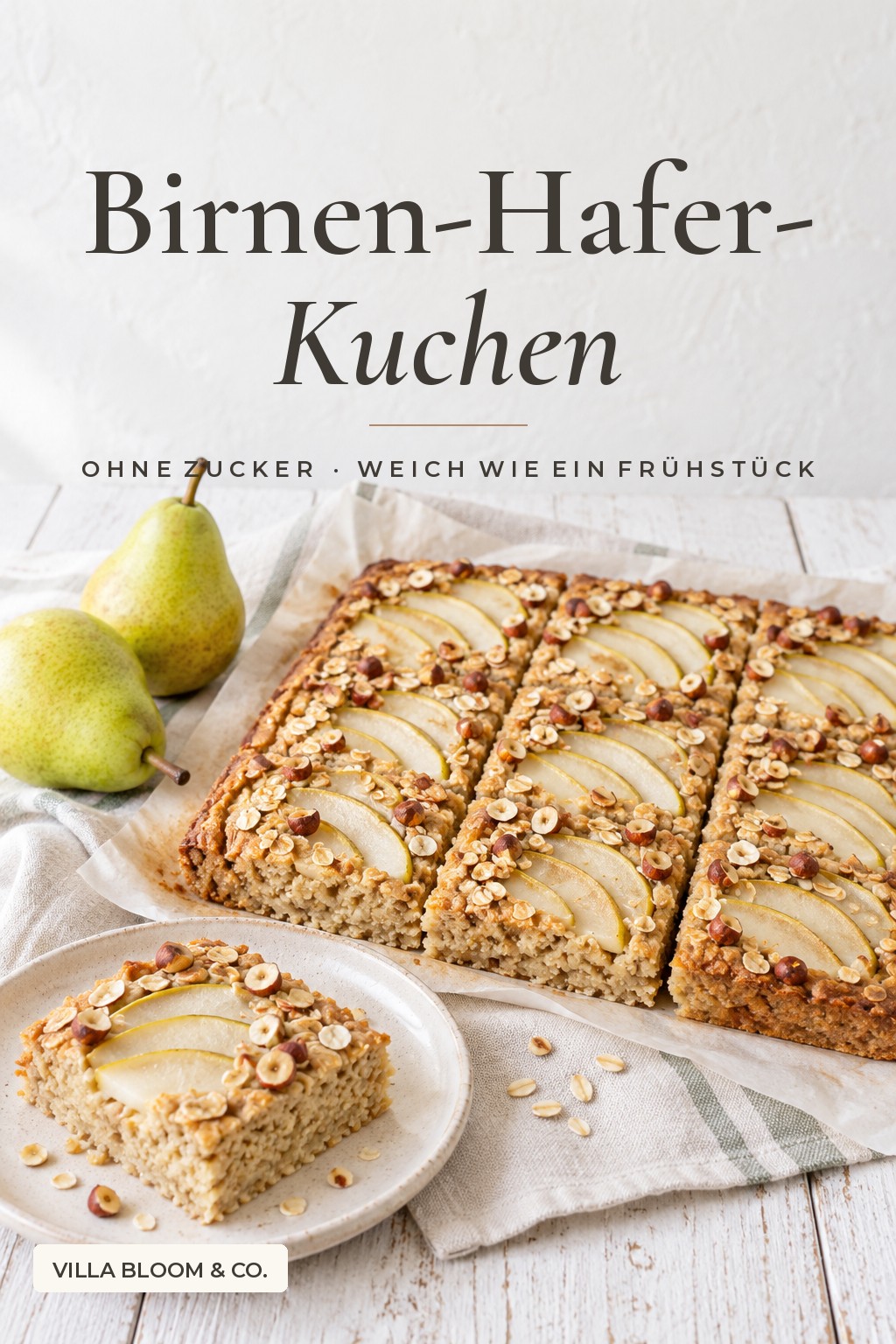
Pear and Oat Tray Bake – no added sugar, soft enough for breakfast
A flat tray bake with rolled oats, yoghurt and ripe pears, sweetened with nothing but dates and fruit. No syrup, no sweetener, no sugar. It is more breakfast than gateau – which is exactly why it belongs on the morning table, in the lunchbox and beside an afternoon cup of tea.

There are cakes you eat in the afternoon, and cakes you could eat in the morning without it feeling like an exception. This one belongs to the second group. Oats in place of half the flour, yoghurt in place of butter, pears that soften on the tray and give their juice to the batter – and dates as the only added sweetness. What comes out is a cake with a dense, moist crumb that recalls baked porridge, only prettier, and that does not leave you sleepy after breakfast.
It is the second sweet part of a small series that began with the apple walnut cake: cakes that do without sugar, syrup and sweeteners and still taste like cake. Where the apple cake is nutty and round, this one is flatter, lighter and paler – the one for everyday.
Why oats and pears go so well together
Rolled oats have a quality that is rarely used in cakes: they bind moisture and release it slowly. A batter with oats therefore stays moist for days without needing much fat. They also bring a gently sweet, cereal note that supports fruit sweetness rather than covering it. Ripe pears are the ideal counterpart: very sweet, very juicy, with a fine, almost floral aroma that grows stronger in the oven. And because pears are so soft, they need no long baking – after 35 minutes they are done, while apples in the same time would often still be firm.
Yoghurt, finally, makes the crumb tender and brings a trace of acidity that keeps the cake fresh. Together with the bicarbonate it makes sure the batter turns out light despite the oats and wholemeal, rather than becoming a bar.
What "no sugar" means here
No table sugar, no syrup, no sweetener – that is the whole rule. The sweetness comes from 120 g of dates, from three ripe pears and a little from the yoghurt. Fruit sugar is of course still in there, as in every cake with fruit. The difference is that it arrives in its natural packaging, with fibre and flavour, and in an amount that fruit does not let you overdo. Anyone eating the cake for the first time notices one thing above all: it is clearly less sweet than a cake from the bakery, and in return the pear tastes of pear.
The full list of ingredients fits in one sentence: dates, pears, rolled oats, wholemeal spelt flour, yoghurt, eggs, rapeseed oil, lemon, baking powder, bicarbonate of soda, cinnamon, cardamom, vanilla, salt, a few hazelnuts. All available organic, nothing that needs explaining.

The ingredients one by one
Rolled oats. 150 g of fine rolled oats. Two thirds are ground to a coarse flour in a blender or food processor – that gives binding and the typical soft crumb. The remaining third stays whole and provides structure. Jumbo oats work too, but the cake becomes more rustic and a little drier; fine oats are the better choice for this recipe.
Dates. 120 g of soft, pitted dates, soaked in hot water for ten minutes and blended smooth with the water. Fewer than in the apple walnut cake, because pears are sweeter than apples. Medjool are the creamiest, Deglet Nour need a little longer in the water.
Pears. Three ripe but still firm pears – Williams, Abate Fetel or Conference. One is peeled and coarsely grated and goes into the batter; it supplies juice and sweetness. The other two are halved unpeeled, cored and cut into slices that are fanned out on top of the batter. They must be ripe, otherwise the sweetness is missing; they must not be too soft, otherwise they collapse in the oven.
Yoghurt. 150 g of plain whole-milk yoghurt, unsweetened. It replaces butter almost entirely, makes the crumb tender and brings the acidity a cake without sugar needs so it does not taste flat. Greek yoghurt works too, then add a splash of milk because it is thicker.
Wholemeal spelt flour. 150 g, as the partner for the oats. Together they make a batter with body that does not become heavy. For a finer texture, use half white spelt flour.
Rapeseed oil. 80 ml of cold-pressed, mild organic rapeseed oil – less than in the apple cake, because yoghurt and pears already bring plenty of moisture. Butter is possible, 80 g melted, and gives a warmer note.
Lemon, spices, nuts. The zest of one unwaxed lemon and a tablespoon of juice for freshness and lift. A teaspoon of cinnamon, a quarter teaspoon of cardamom, a teaspoon of ground vanilla, half a teaspoon of salt. And for the top, 30 g of coarsely chopped hazelnuts with two tablespoons of oats – walnuts or almonds work equally well, or nothing at all, in which case the surface stays smooth and the pear fans show more clearly.
The recipe
Pear and Oat Tray Bake
20 minutes of work · 35–40 minutes in the oven · 20 × 30 cm tin
Ingredients for a small tray or tin of 20 × 30 cm (about 12 pieces)
- 120 g soft organic dates, pitted
- 100 ml hot water
- 150 g fine rolled oats (100 g ground, 50 g whole)
- 150 g wholemeal spelt flour
- 2 tsp baking powder
- ½ tsp bicarbonate of soda
- 1 tsp cinnamon, ¼ tsp ground cardamom, 1 tsp ground vanilla
- ½ tsp salt
- 3 medium eggs
- 150 g plain whole-milk yoghurt
- 80 ml mild, cold-pressed organic rapeseed oil
- zest of 1 unwaxed lemon and 1 tbsp juice
- 3 ripe, firm pears (e.g. Williams, Abate Fetel or Conference)
- 30 g hazelnuts, coarsely chopped, and 2 tbsp rolled oats for the top
- a little oil for the tin, baking paper
- Soak the dates. Roughly chop the dates, pour over the hot water and leave for ten minutes. Preheat the oven to 180 °C (conventional). Line the tin with baking paper and lightly oil the sides.
- Grind the oats. Grind 100 g of the oats to a coarse flour in a blender or food processor – not dust-fine, a little texture should remain. Mix with the remaining 50 g whole oats, the flour, baking powder, bicarbonate, spices and salt in a bowl.
- Blend the date purée. Blend the dates with their soaking water until very smooth. Add yoghurt, eggs, oil, lemon zest and juice and whisk until smooth.
- Grate a pear. Peel one pear, grate it coarsely and stir it into the wet mixture with its juice.
- Bring the batter together. Add the dry mixture to the wet and fold only until combined. The batter is thick but flows slowly – that is how it should be. Leave for five minutes so the oats can swell.
- Top. Spoon the batter into the tin and level it. Halve the remaining two pears unpeeled, remove the cores and cut into slices. Fan them out in rows on the batter and press in lightly. Scatter the chopped hazelnuts and oats over the top.
- Bake. 35–40 minutes, until the surface is golden, the pear edges have taken a little colour and a skewer comes out clean.
- Cool. Rest in the tin for at least 20 minutes, then lift out by the baking paper and cut into twelve pieces. Lukewarm it is at its softest, cold at its moistest.
Tip: The cake keeps for five days in the fridge, which makes it a true batch bake: made on Sunday, it covers breakfasts until Thursday. A piece warmed briefly in the toaster or a dry pan, with yoghurt and a few fresh pear slices – no more breakfast is needed.

Two variations for other weeks
Plum and oat tray bake. Now with a page of its own and a crunchy top. In September and October almost better still than with pears: instead of the two topping pears, halve and stone 400 g of plums and set them cut side up, close together, on the batter; the grated pear in the batter stays. Plums are more acidic, so raise the dates to 150 g. Baking time unchanged; the plums sink in slightly and leave a dark red rim of juice that suits the cake well.
Apple and oat tray bake with raisins. For winter, when pears become scarce: two tart apples in thin slices instead of the pears, plus 60 g of raisins in the batter, soaked for ten minutes in hot water beforehand. The raisins add sweetness, the apples acidity, the cake becomes a little more robust and suits a strong black tea.
What to serve it with
In the morning, with a spoonful of yoghurt and fresh fruit, a piece replaces the muesli, and it can be eaten without a bowl – for those who breakfast on the move. In a lunchbox it stays soft, does not stick and survives even a warm morning. In the afternoon with tea it needs nothing more; if you like, add a spoonful of skyr or quark. And as a dessert, lukewarm with unsweetened yoghurt and a few toasted hazelnuts, it looks far more festive than its effort suggests.

Keeping and freezing
In the fridge, covered or in a tin, the cake keeps for five days; the oats hold the moisture in the crumb, it does not dry out. At room temperature two days, no longer, because of the yoghurt in the batter. To freeze, cut into pieces and stack with baking paper between them, for up to three months. Thaw at room temperature, or put a frozen piece straight into the toaster – that works surprisingly well with this cake and is the quickest way to a warm breakfast.
Frequently asked questions
- Can I use gluten-free oats and a gluten-free flour?
- Yes. Certified gluten-free oats plus 150 g of a gluten-free flour blend with binder work well. The cake turns out a little more crumbly; an extra tablespoon of yoghurt balances that.
- Why is my cake still wet in the middle?
- Usually the tin was too small or the pears very juicy. In a 20 × 30 cm tin the batter is about three centimetres deep – in a smaller tin it is deeper and needs longer. If in doubt add five minutes and cover with baking paper once the top is already dark.
- Can I replace the yoghurt?
- With skyr, quark loosened with a splash of milk, or an unsweetened plant-based alternative. Some acidity matters – with plant yoghurt an extra half tablespoon of lemon juice is worth adding.
- Can the cake be made vegan?
- Yes, with plant yoghurt and three tablespoons of ground flaxseed stirred into nine tablespoons of water and left to swell for ten minutes, in place of the eggs. It becomes denser but stays moist. Extend the baking time by five minutes.
- Do I really have to grind the oats?
- Not strictly, but it is worth it: ground oats bind like flour and give the soft, even crumb. With whole oats only, the cake becomes more rustic and drier, more like an oat bar.
- How sweet is it really?
- Clearly less sweet than a cake from the bakery – about as sweet as a piece of ripe fruit. If you prefer it sweeter, use 150 g of dates instead of 120 g, or particularly ripe pears. Anyone eating it for breakfast soon comes to appreciate the restraint.
Read on
The apple walnut cake with no added sugar is the rounder, nuttier sibling of this bake – and the roasted pepper chili hummus the savoury counterpart in the same series. The German edition of this recipe is at Birnen-Hafer-Kuchen vom Blech.